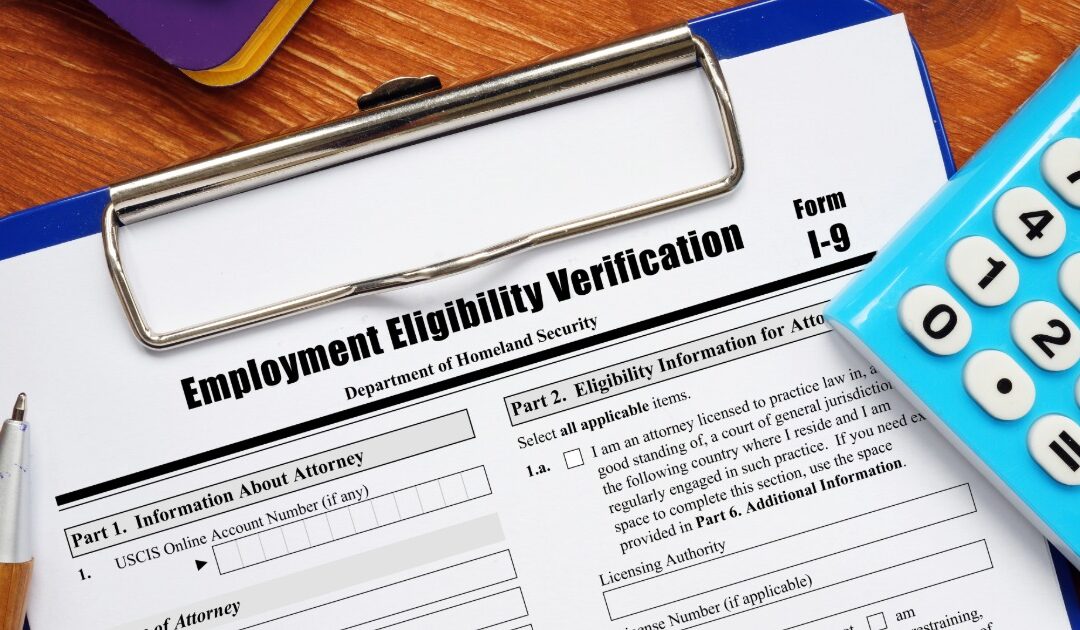
If your inbox is like mine, there are plenty of emails advertising webinars and training to comply with the new policy changes under this Administration. That said, there have not been major structural changes to the Form I-9 itself directly enacted by the Trump administration, but there have been significant policy and enforcement changes affecting I-9 compliance. For employers, the most meaningful shifts fall into three categories: enforcement, verification methods, and related immigration policy changes.
Here’s a summary of Key I-9 Changes Under the Trump Administration:
- Much Stronger Enforcement of I-9 Compliance
The biggest change has been enforcement intensity, not the form itself.
- Sharp increase in ICE I-9 audits and worksite investigations.
- Increased workplace raids and inspections.
- Higher civil penalties for I-9 violations.
- Greater focus on industries with immigrant labor (construction, agriculture, food processing, hospitality).
For example, ICE conducted over 6,400 I-9 audits in FY2019, roughly double the typical number under the prior administration. Recent reporting indicates the current administration has also increased quotas for employer inspections and I-9 audits as part of broader immigration enforcement.
What this means for employers:
- Internal I-9 audits are strongly recommended. We can help with this!
- Recordkeeping errors are more likely to trigger fines. Be sure to have employees who complete the I-9s do so correctly.
- Those completing the I-9s must be trained in document verification rules.
- Greater Emphasis on E-Verify
The administration has consistently promoted expanding E-Verify, the electronic system that checks I-9 data against government databases. Possible policy directions have included:
- Making E-Verify mandatory nationwide.
- Linking federal contracts to E-Verify participation.
- Increased enforcement around mismatches and verification failures.
To provide some context, E-Verify compares employee information from the I-9 with Social Security Administration and DHS databases to confirm employment eligibility. E-verify is required if you can’t view the required I-9 documents in person, screens do not replace in person verification. Even if E-verify is not mandatory, employers are being encouraged to use it to demonstrate compliance.
E-verify is easy to set up – it’s a free account. The only time it is a hurdle is during government shut downs; then employers likely have to wait to add their already completed I-9s into the E-verify system.
- Increased Scrutiny of Work Authorization Programs
Policy changes affecting immigration programs indirectly affect I-9 compliance.
Examples include:
- Ending or restricting Temporary Protected Status (TPS).
- Efforts to terminate DACA.
- Revocation or expiration of humanitarian parole programs.
- Tighter rules around Employment Authorization Documents (EADs).
When work authorization programs change, employers must reverify employment eligibility on the I-9 for affected workers.
- More Aggressive I-9 Audits and Penalties
Legal and compliance experts expect significant increases in audits and investigations under the current administration. Typical penalties include:
- $288–$2,861 per I-9 paperwork violation.
- $716–$28,619 per unauthorized worker.
- Possible criminal liability for patterns of violations.
Employers are encouraged to conduct internal “good faith” audits to correct errors before government inspections. Milestones HR LLC can conduct your I-9 audits with ease. We offer comprehensive fractional HR services. Reach out to us at Milestones HR, LLC at 608-370-4642 or angie@milestoneshr.com for a free, no obligation 30-minute exploration conversation. Check out our website at www.milestoneshr.com for all of our fractional human resources services.
 Angie Addison, SHRM-CP, PHR
Founder & Owner of Milestones HR, LLC
www.milestoneshr.com